Sometimes the best learning experiences begin when you enter a room, or, in my case, an entire industry, where you know almost nothing.
When I joined Regeneron as a Commercial Training intern in the summer of 2026, I was stepping into a world very different from the one I knew. My background had been shaped largely by higher education, instructional design, educational technology, research, and eLearning development. Suddenly, I was working in the pharmaceutical industry, surrounded by new terminology, new systems, new roles, new business priorities, and people whose professional experiences were very different from mine.
It was exciting. It was intimidating at times. And it became one of the most valuable professional learning experiences I have had.
What made it especially memorable was that the internship did not begin with me sitting alone behind a laptop trying to figure everything out.
It began with a surprise trip to Seattle.
Day One: Apparently, We’re Going to a Baseball Game
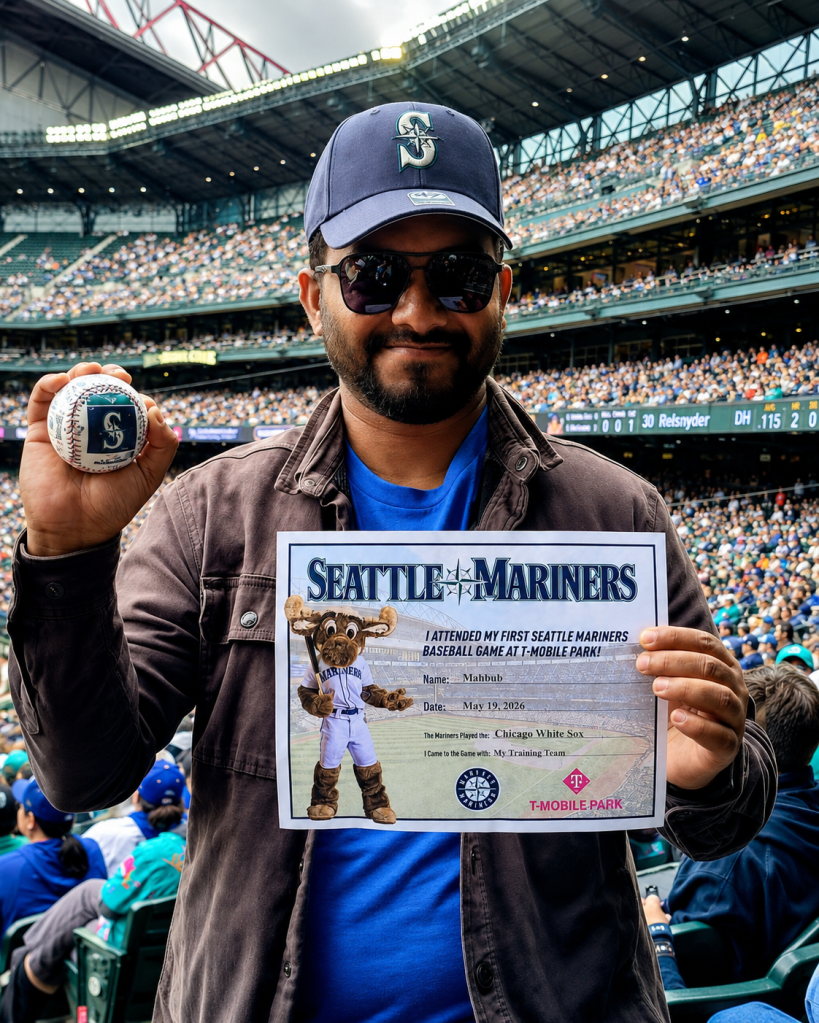
On my very first day with the team in Seattle, I received a surprise: we were going to a Seattle Mariners game.
My supervisor had even arranged a few gifts to mark my first Mariners experience. I received a baseball, Mariners gear, and a certificate commemorating my first game at T-Mobile Park.
I had come prepared to begin an internship.
I had not expected baseball.
Looking back, though, that first day captured something important about the experience that followed. Before I knew all the acronyms, understood the systems, or had contributed anything substantial to the team, people made an effort to make me feel welcome.
For an intern entering a new company, and an entirely new industry that mattered.
There is a big difference between being introduced to an organization and feeling that someone has actually invited you into it.
That evening gave me the latter.
Meeting the People Behind the Teams Calls
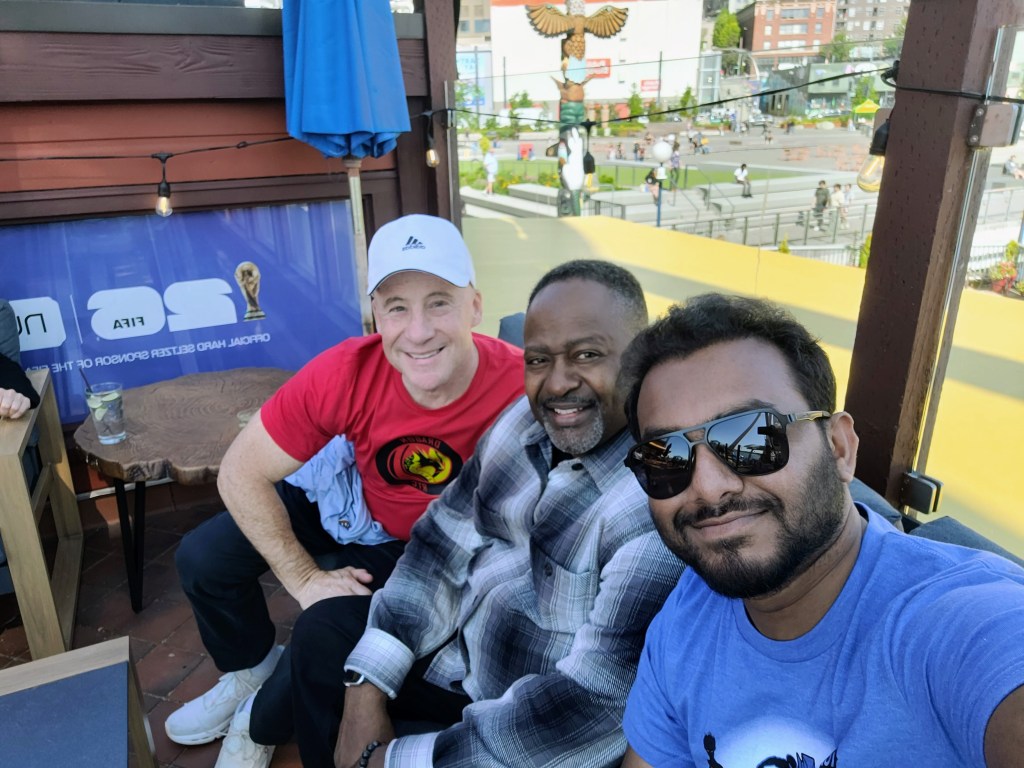
Because my internship was remote, Seattle also gave me something I would not otherwise have had so early in the summer: the opportunity to meet people face-to-face.
These were people I would later see in meetings, collaborate with, learn from, and reach out to with questions. But instead of first knowing them as small rectangles on a Teams screen, I got to talk with them over meals, walk around the city with them, laugh with them, and hear about their experiences.
That human connection changed the rest of my internship.
It also reminded me of something we sometimes forget when we talk about organizations, departments, or “stakeholders”: behind all those structures are simply people.
People with expertise.
People with challenges.
People trying to do their jobs well.
People who know things you do not.
And people who are often incredibly generous about helping you learn.
That realization became particularly important later when I began conducting needs assessments and stakeholder interviews. A good interview is not simply a mechanism for extracting information. It starts with curiosity about someone else’s experience.
Seattle, Between the Learning
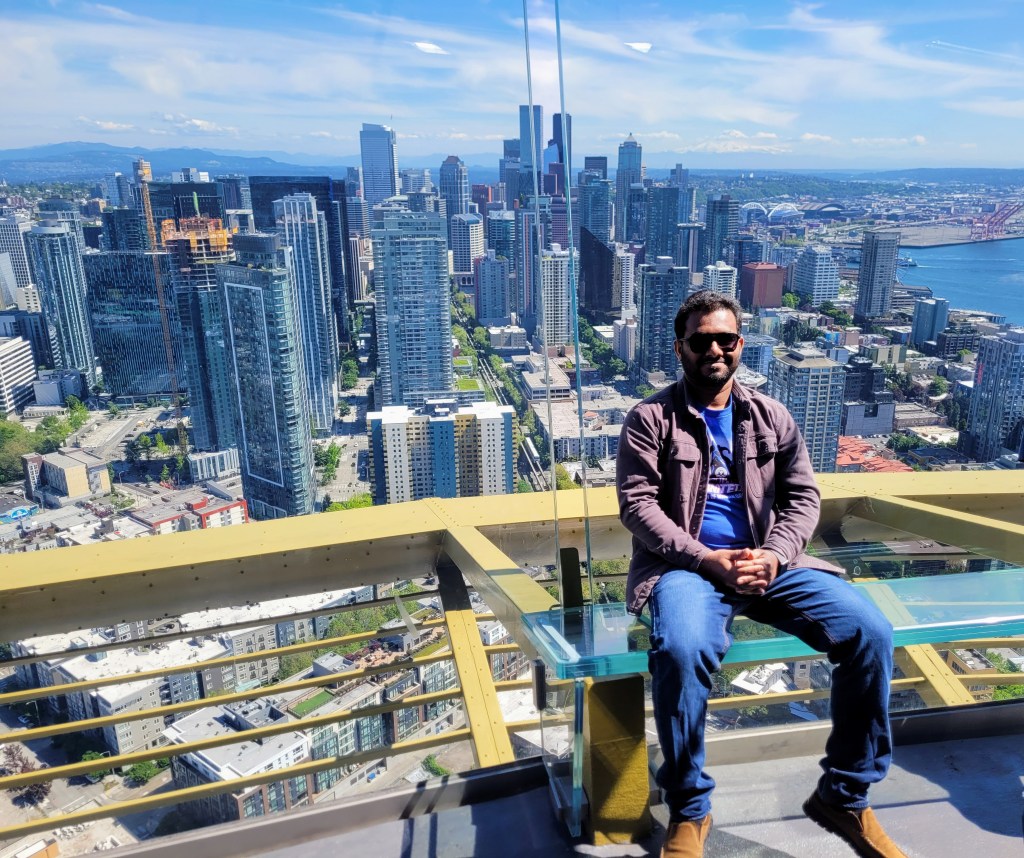
Of course, we also explored.
Seattle was completely new to me, and between the professional activities, I tried to experience as much of the city as I could.
At some point during the trip, sitting above that skyline, I remember appreciating how strange and exciting the whole experience felt.
My path into instructional design had already crossed countries, educational settings, freelance projects, universities, and different kinds of learners. Now it had somehow brought me here—to Seattle, working with a biotechnology company and learning how commercial training operates in the pharmaceutical industry.
Careers rarely unfold as neatly as the diagrams we draw for them.
I am increasingly thankful for that.
Seeing Learning From a Different World
The professional side of the trip was just as important.
Coming from academia, I was accustomed to thinking about learning in terms of courses, students, objectives, assessment, engagement, and educational outcomes.
Corporate learning required many of those same ideas—but placed them inside a different ecosystem.
Here, learning was intimately connected with performance.
What does someone need to know to perform effectively?
What happens during onboarding?
Where are employees struggling?
What resources already exist?
What information is missing?
What is a training problem, and what only looks like one?
What would actually help people do their jobs better?
Those questions gradually changed how I thought about instructional design.
I began to see the instructional designer less as someone who creates training and more as someone who investigates problems.
And investigation became a major part of my summer.
Learning to Listen Before Designing
One of my biggest projects involved examining the new-hire training experience.
Rather than beginning by designing another course or resource, the work required understanding the existing experience first: what new hires encountered, what worked, where inconsistencies existed, what trainers needed, and how the process could be strengthened.
That meant research.
It meant conversations.
It meant looking for patterns across different sources of information and turning those patterns into practical recommendations.
Eventually, that work contributed to the development of a Commercial New Hire Training Playbook, a resource designed to provide greater structure and consistency around onboarding and training.
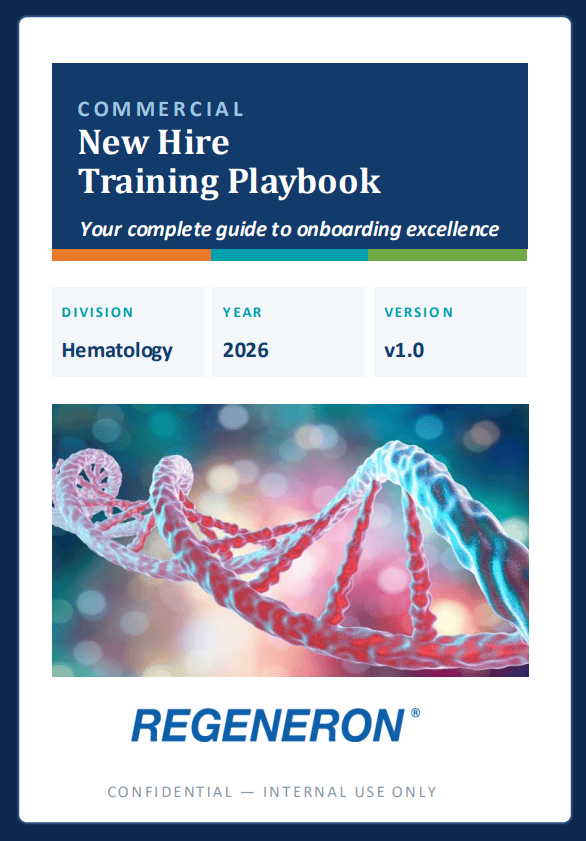
Suggested caption: One of my major summer projects focused on strengthening the new-hire training experience through needs assessment and the development of a structured training playbook. Proprietary content is not displayed.
Seeing something move from interviews and scattered observations to a tangible product was incredibly satisfying.
But the artifact itself was only part of what I learned.
The more important lesson was the process behind it.
Before we build something, we need to understand what problem we are actually trying to solve.
That sounds obvious.
In practice, it requires discipline.
Nine Interviews, Sixty-Three Pages, and a Much Better Appreciation for Needs Assessment
Another major project pushed that lesson further.
I conducted nine interviews with directors as part of a needs assessment. Those conversations eventually became a detailed 63-page report synthesizing the needs, patterns, challenges, and opportunities that emerged from the data.
This was one of the parts of the internship where my researcher identity and instructional designer identity came together most clearly.
Interviewing stakeholders felt remarkably similar to qualitative research.
You prepare questions, but you also follow interesting directions.
You listen for what people say—and sometimes what they repeatedly do not say.
You compare perspectives.
You look for patterns without flattening important differences.
Then comes the difficult part: turning a large amount of information into something useful for decision-making.
It reinforced one of the ideas I now carry strongly into my work:
Needs assessment is not the step before instructional design. Needs assessment is instructional design.
Sometimes the highest-value contribution we can make is not another module.
Sometimes it is helping an organization understand the problem more clearly.
Being a Beginner Again
Entering pharma also meant learning an entirely new language.
There were meetings early in the internship where acronyms seemed to reproduce faster than I could write them down.
Products. Roles. Teams. Processes. Platforms. Business terminology.
At first, it was difficult to keep up.
And that was good for me.
Instructional designers regularly walk into environments where the subject matter experts know far more than we do. The experience reminded me that our job is not to pretend otherwise.
Our job is to become good learners.
I asked questions.
I kept notes.
I looked things up.
I listened carefully.
And slowly, conversations that had initially sounded foreign became understandable.
Being comfortable saying I don’t know this yet may be one of the most underrated professional skills I developed that summer.
Learning About Learning
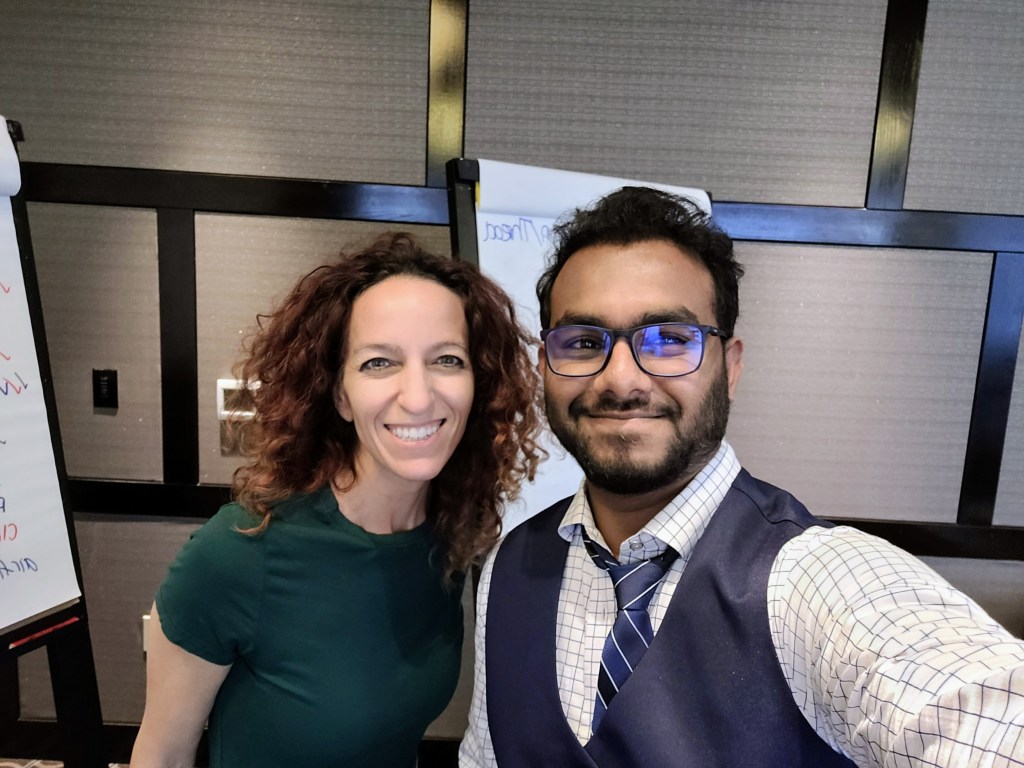
One particularly memorable part of the Seattle experience was participating in a learning session facilitated by Lauren Waldman.
As someone who spends so much time thinking about how people learn, I found myself doing two things at once during sessions like this: participating as a learner while also observing the experience as an instructional designer.
- How is attention being managed?
- How are people being invited into the conversation?
- What makes an idea memorable?
- What gets people talking?
What does good facilitation look like when the audience consists of experienced professionals rather than students in a classroom?
Experiences like this expanded my conception of learning design beyond courses and eLearning.
Learning can happen in a module.
But it can also happen through conversation, facilitation, reflection, coaching, shared experiences, job aids, communities, and carefully designed moments.
The designer’s canvas is much larger than a screen.
Somewhere on the Water
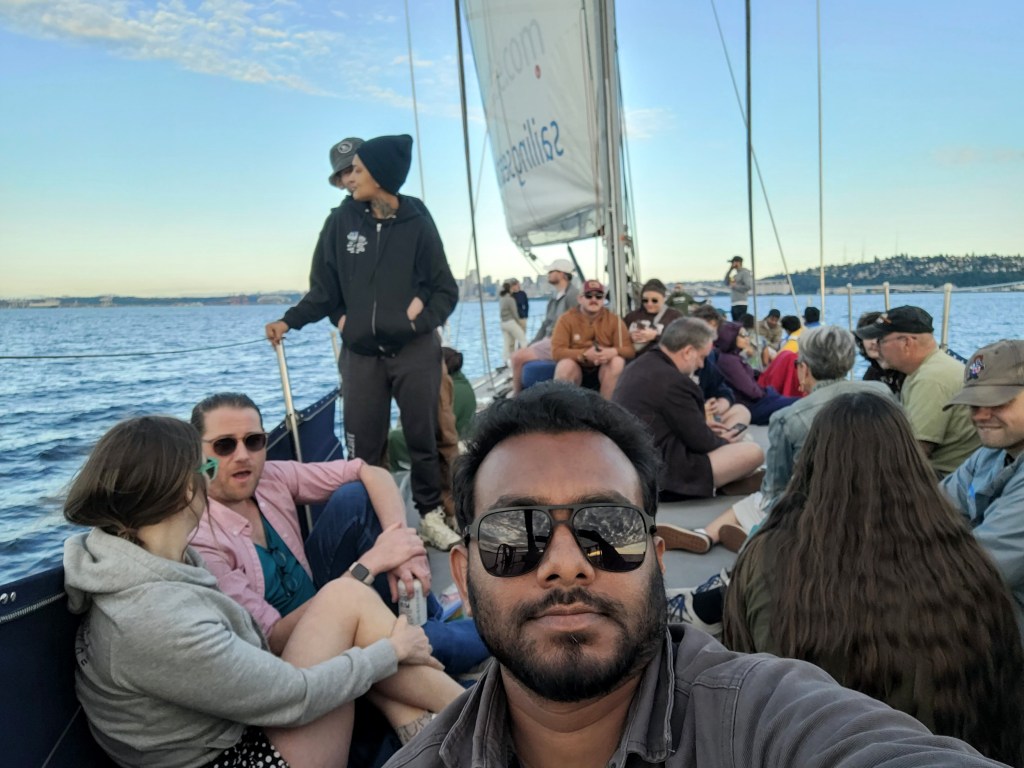
And then there were moments that had absolutely nothing to do with needs assessments, learning objectives, or instructional design.
Like being on a sailboat.
Those moments belong in the story too.
One thing I loved about the Seattle trip was that it allowed the professional and the personal sides of the experience to coexist. We learned together, but we also ate together, explored together, joked around, and experienced a new city.
Those informal moments helped turn colleagues into people I felt comfortable approaching later.
And for someone joining an organization remotely, that kind of relationship-building was invaluable.
A City From the Water

I took this photo while looking back at the Seattle skyline from the water.
At the time, it was simply a beautiful view.
Looking at it now, it feels like an appropriate image for the whole summer.
I was experiencing a professional world from a perspective I had never seen before.
More Than Tools
Throughout the internship, I also worked with tools and platforms including Rise 360, ACTO LMS, TalentHub, interactive PDFs, Microsoft Copilot, and Claude.
Those experiences expanded my technical toolkit, but strangely, technology is not what I remember most when I think about the summer.
I remember the questions.
I remember interviews.
I remember feedback.
I remember trying to make sense of messy information.
I remember presenting ideas and revising them.
I remember people trusting me with meaningful work.
The internship reinforced something I have increasingly come to believe about instructional design:
Our value is not determined by how many tools we know.
Tools change.
What matters much more is whether we can understand people, investigate problems, communicate clearly, work with subject-matter experts, make sense of evidence, and design something appropriate for the context.
Technology helps us build.
Thinking helps us decide what is worth building.
Bringing My Worlds Together
Before Regeneron, I sometimes thought of my different professional identities as separate pieces.
I was a researcher.
I was an instructional designer.
I had a background in TESOL.
I worked in higher education.
I developed eLearning.
I studied educational technology.
At Regeneron, those boundaries became much less meaningful.
When I interviewed directors, I was using skills from qualitative research.
When I analyzed needs, I was drawing on instructional design.
When I translated complex information into accessible resources, I was drawing on years of teaching and communication work.
When I thought about AI tools, usability, learning experiences, and performance support, I was connecting my academic interests with workplace realities.
The experience helped me realize that I do not necessarily have to choose between being a researcher and being a practitioner.
The most interesting work may exist precisely where those identities meet.
The Gift of Being Trusted
Perhaps the biggest difference between simply completing an internship and having a meaningful internship is ownership.
I was not interested in spending a summer producing practice work that disappeared into a folder when I left.
At Regeneron, I was trusted with projects connected to real needs.
That trust also brought responsibility.
When nine people give you their time for interviews, your analysis needs to honor that time.
When a resource may eventually support real employees, its usability matters.
When you make a recommendation, you need to be able to explain where it came from.
That responsibility made the work meaningful.
It also made me more confident.
Not because I suddenly knew everything about pharmaceutical training—I certainly did not—but because I had evidence that I could enter an unfamiliar environment, learn quickly, collaborate with experts, and contribute something useful.
The Internship Ended. The World Got Bigger.
By August, the industry that had seemed completely foreign a few months earlier was no longer quite so foreign.
I had learned about commercial training.
I had conducted stakeholder interviews and needs assessments.
I had developed resources.
I had learned new technologies.
I had experienced another side of instructional design.
But when I think back on the summer, my favorite memories are still remarkably human: being surprised with a baseball game on my first day, meeting colleagues in person, exploring Seattle, learning from people with very different expertise from mine, being out on the water, and realizing that I had found another professional space in which I could contribute.
I entered Regeneron thinking I was going to learn about corporate instructional design.
I did.
But I also learned something about myself.
I learned that I enjoy walking into worlds I do not completely understand yet.
I enjoy asking questions.
I enjoy finding patterns.
I enjoy working at the intersection of research, learning, technology, and real organizational problems.
And I learned that sometimes the best professional experiences do more than add another line to your résumé.
They make your world bigger.

