I’ve been spending time recently revisiting some foundational and contemporary readings in instructional design, and together they’ve helped me clarify how I think about theory, practice, and uncertainty in our field. In particular, Reigeluth (1999), Snelbecker (1999), and Bond et al. (2023) collectively challenge the idea that instructional design should aim for certainty, perfection, or guaranteed outcomes—and that feels especially relevant in today’s AI- and systems-driven educational landscape.
Descriptive vs. Prescriptive: Knowing vs. Designing
Reigeluth (1999) draws a clear distinction between descriptive theories, which explain how learning happens, and prescriptive (instructional design) theories, which guide what we should do to support learning. This distinction matters because it reminds us that instructional design is fundamentally goal-oriented and action-focused, not explanatory in the way traditional sciences often are.
What resonates with me is Reigeluth’s emphasis on probability rather than certainty. Instructional methods don’t guarantee learning; they increase the likelihood of it. That framing alone removes a lot of pressure to treat instructional design as a formulaic or mechanistic process.
Letting Go of “Perfect” Theories
Snelbecker (1999) pushes this idea even further by warning against treating any theory as complete, final, or universally applicable. He argues that theories are tools for thinking, not truths to be defended. This really reframed how I think about “failed” instructional designs.
In many scientific fields, failure can mean the end of the road. I was reminded of this recently when a friend in Biochemistry told me that if her experiment doesn’t produce the expected result, the work is essentially futile. That logic makes sense in hard sciences that seek to confirm specific mechanisms. But instructional design operates in a very different space.
In ID, when something doesn’t work as planned, it’s rarely meaningless. Instead, it often reveals contextual variables, learner differences, institutional constraints, or design assumptions we hadn’t fully accounted for. In other words, failure is not wasted effort—it’s information.
Instructional Designers as Change Agents
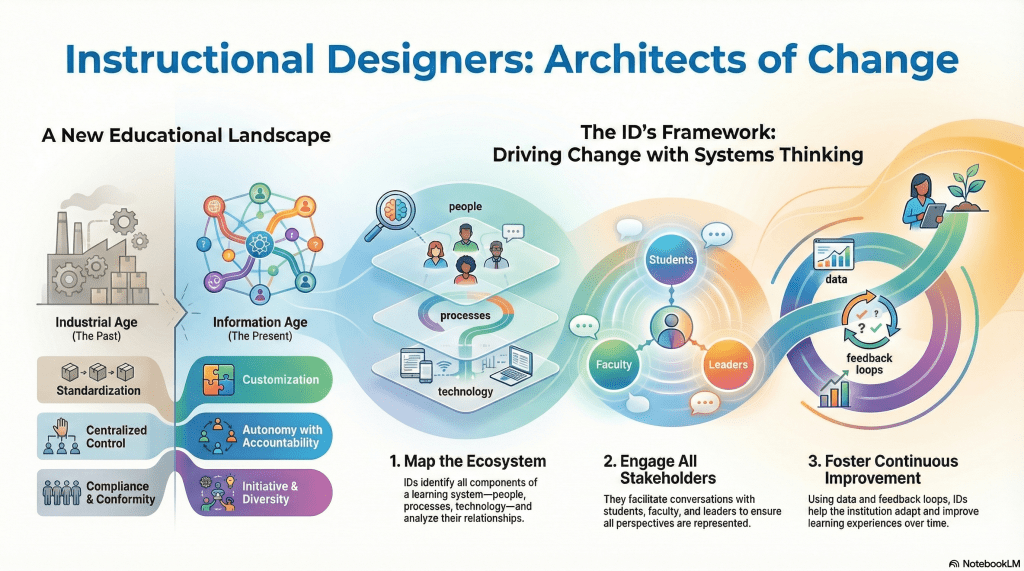
Bond, Lockee, and Blevins (2023) bring these ideas into the institutional arena by positioning instructional designers as systems-level change agents. Their argument reinforces why instructional design can’t—and shouldn’t—be treated like a traditional science. Designers work across stakeholders, policies, technologies, cultures, and power structures. Success is rarely linear, and outcomes are shaped by far more than the quality of a single design decision.
From this perspective, instructional design is less about producing perfect solutions and more about facilitating learning, adaptation, and improvement over time. Iteration, feedback loops, and long-term thinking are not signs of weakness—they are essential features of the work.
Why I’m Sharing a NotebookLM Video
To support this reflection, here’s a short video generated using NotebookLM, which helped me synthesize these readings and surface connections across them. I don’t see tools like NotebookLM as replacements for thinking, but as thinking partners—ways to revisit ideas, notice patterns, and refine my own interpretations.
Much like instructional design itself, the value of these tools lies not in perfect outputs, but in how they support reflection, sensemaking, and redesign.
Final Thought
Taken together, these readings remind me why I’m drawn to instructional design in the first place. It’s a field that embraces uncertainty, values context, and treats learning as a human, evolving process. In instructional design, outcomes don’t always look the way we expect—but they almost always teach us something worth carrying forward.
 Mahbub Amin